Trigonometry Behind Penultimate Units
Exact angles allow Penultimate units to avoid many of the annoying angle bounds present in many "stretchy" units. (For example, PHiZZ units can only form angles greater than 90°.) This is what makes Penultimate units versatile.
Breakdown of Penultimate Unit Angles
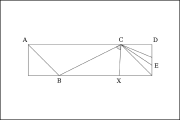
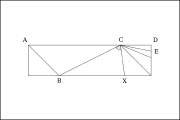
The main idea is that ∠BCX in the diagram must be the interior angle measure of our desired polygon. (Observe that triangle BCX is the main body of the piece, and anything to the right of line CX is inserted into another piece. Point C will be the vertex of the angle.) Using standard trigonometric tools and an origami axiom, we may construct the angles that we need by pure folding.
Axiom #3 of the Huzita-Hatori Axioms states that given two lines, there is a fold that places the first line onto the second line. We will use the fact that this fold is the angle bisector of the original two lines.
Below are the angle calculations for several common angles.
Triangle. Unfortunately, this is only a very good approximation:
∠BCX=∠BCE/2
=(180°-∠BCA-∠DCE)/2
=(180°-arctan(1/2)-3/4(45°))/2
≈59.84°
≈60°
(There is a simple sequence of folds to get an EXACT 60° angle, but it is impractical because it creates creases on the visible body. Can you figure out the sequence? Click this page for a hint.)
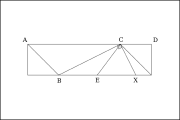
Square. Very clean. Without doing any trigonometric computation, we can get exactly 90 degrees:
∠BCX=∠BCE+∠XCE
=∠ACE/2+∠DCE/2
=180°/2
=90°
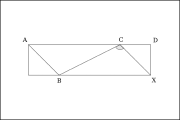
Pentagon. This is also only a close approximation:
∠BCX=180°-∠BCA-∠DCX
=180°-arctan(1/2)-45°
≈108.43°
≈108°
(In theory, an exact 108° angle can be created using pure folds. However, it is very impractical here. If you're interested, see this page.)
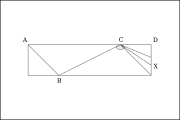
Hexagon. Same as the triangle, but without the ÷2 at the end:
∠BCX=180°-∠BCA-∠DCX
=180°-arctan(1/2)-3/4(45°)
≈119.68°
≈120°
(An exact 120° angle can be created using the 60° construction plus one additional step of reflecting it across the 90° mark using a fold.)
Design Your Own Pieces
Using similar ideas as above, you can fold a lot more than these four simple regular polygons. Keep in mind that the larger the angle, the smaller the attaching flap, so anything greater than an octagon will be unstable to use.
Here's an example to get started. The Rhombic Dodecahedron is a solid consisting of 12 rhombic faces with length-to-width ratio √2:1. Consider the acute angle of this specific rhombus, which I designed my own piece for:
Acute angle of the rhombus. The desired angle is exactly 2arctan(1/√2), or ≈70.53°. The idea is to bisect the top-right 45° angle twice and then fold inwards, much like the triangle.
∠BCX=∠BCE/2
=(180°-∠BCA-∠DCE)/2
=(180°-arctan(1/2)-1/4(45°))/2
≈71.09°
≈2arctan(1/√2)°
(Note: Clever inside folds are required before this piece can be used in practice, just like the triangle. I'll leave the details as an exercise.)
The obtuse angle of the same rhombus is 180°-2arctan(1/√2)≈109.47°, which can be approximated using the pentagon piece. Exact angles are possible but impractical to implement onto the Penultimate unit.